An Entity Component System (ECS) is a software architecture used primarily for video games where entities are comprised by components of data. This data is stored as closely to each other as possible for easy and fast reading and modification. This architecture heavily benefits from CPU memory caching which improves performance.
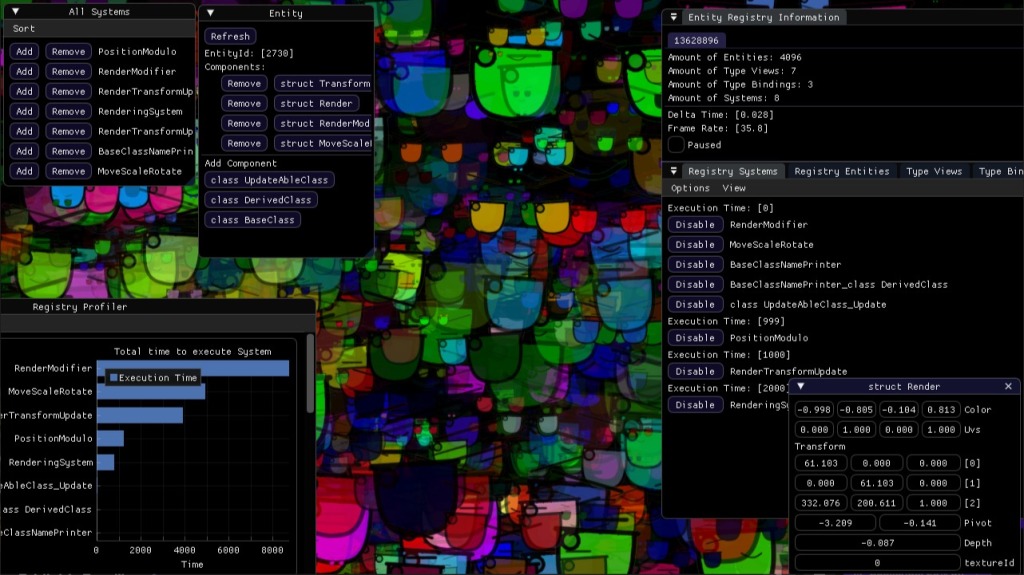
Entity
An Entity consist of 2 elements:
EntityId: either a 4 or 8 byte unsigned integer depending on the system architectureEntityRegistryreference: A Reference to the Entity Registry it is contained in
The EntityId is the most important part of the Entity class. When interacting with the Entity Registry it is only necessary to have the EntityId to add/remove/get Components.
Game Object
The Game Object class is a wrapper class for the Entity class. It allows for easy adding/getting/removing of Components and will remove itself from the registry upon destruction.
Component
A Component is any class or struct that contains data. It does not have to inherit from any base class. It should have its move constructor and operator= intact for it to be able to work.
Member methods can be added to personalize functionality for various stages of the Components lifetime:
Serialize(std::ostream&): define custom Serialize logic for when the the Component has to be serialized to a stream.Deserialize(std::istream&): define custom logic for initializing Component reading from a stream.Initialize(EntityRegistry*): custom logic for when the Component is added to the registry.bool SortCompare(const Component&, const Component&): custom logic for when Components have to exist in a sorted state as much as possible.- Default System Methods: methods that will automatically be called without having to create a system for it.
References
Because Data is stored in contiguous array, they will sometimes have to move whenever the underlying array has to resize. Because of that you references/pointers to components are passed may be passed around by Reference<Component>. It contains a pointer to the class ReferencePointer<Component> that is static in memory and contains the pointer to the Component. Every time the underlying array gets resized, all the ReferencePointer<Component> get their pointers updated. These are similar to std::shared_ptr as they will always point to either a valid component or a nullptr in case the Component has been removed. They will also only be deleted from memory when no reference exists that points to it.
Entity Registry
The EntityRegistry is the class that contains all the Entities, TypeViews, and Systems. It is a controller responsible for managing most resources and is the most important part of the ECS. It contains an Update(float deltaTime) method that should be called with the deltaTime whenever you want to update the Entities, Components and Systems.
Type View
The TypeView<Component> class is the container for all the Components in a registry. It is responsible for managing the References and resizing data whenever it needs to.
Type Binding
TypeBinding<Components...> are similar to Type Views as they allow quickly accessing multiple Components that are all connected to the same Entity. Type bindings can be initialized with any amount of Components as long as the number is bigger than 1. example:
auto typeBinding = TypeBinding<Transform, Physics, Render>{...}will create a TypeBinding that contains references to the Components Transform, Physics, Render. Whenever an entity exists with these components it will be added to the TypeBinding. You may then access the references and call functions on them and/or transfer data between them. It also contains a method to call function on them. For example:
ApplyFunctionOnAll<Transform, Physics, Render>([](Transform& transform, Physics& physics, Render& render) {...} );Will call the lambda function on the mentioned Components of an Entity that contains all of them.
Warning: you may only have one TypeBinding with the specific Components. You may not have TypeBinding<Transform, Render> and TypeBinding<Render, Transform> at the same time. This also applies for Systems.
System
A system is a process that modifies or acts on one or multiple components. All Systems inherit from SystemBase, an abstract class that contains the following virtual methods that can be overridden in a custom System:
Execute(): Should contain the functionality of the system, modifying or using the components.Initialize(): Is called after construction when the TypeView or TypeBinding is set
When constructing a System it requires SystemParameters which contains the following information:
- Name of the system
- Execution time: an integer to specify when it should execute compared to other systems. Systems with lower Execution time will execute before Systems with higher Execution time.
- Update interval: How long it takes between each Execute call. if 0 it will execute every frame.
Systems also have the method GetDeltaTime() which returns the deltaTime variable. This may be different for each system depending on the Update Interval.
All Systems should have a constructor taking only const SystemParameters&
View System
System that contains a reference to a TypeView and used to act on a specific Component. You can get the Type View by using the GetTypeView() method.
Binding System
System that contains a reference to a TypeBinding and used to act on multiple Components at the same time. You can get the Type Binding by using the GetTypeBinding() method.
Dynamic Systems
Dynamic Systems are either View Systems or Binding Systems that are easy to create as they only need a function taking the Component References as input parameters.
There also exist Dynamic Systems DT (deltaTime) taking the same type of functions but with a float parameter at the start.
Sub Systems
Sub Systems are systems that act on Components that inherit from other Components. A system will get made calling the same function on the derived class. this way you can still get access to polymorphic function calling.
Default Systems
These systems are created whenever a specific method exists in the Component. When any of the following methods exists a system will automatically be created to call them:
PreUpdate(float deltaTime)Update(float deltaTime)LateUpdate(float deltaTime)Render()LateRender()
You can also specify the Update interval by creating a static floating point variable inside the class given the corresponding name:
PreUpdateIntervalUpdateIntervalLateUpdateIntervalRenderIntervalLateRenderInterval
example:
struct Transform
{
    static constexpr float UpdateInterval{ 0.16f }
    void Update(float deltaTime);
};
Sorting
Whenever a Components have to exist in a sorted state you can specify a function by the signature of bool SortCompare(const Component&, const Component&). If this function exists they Components will try to stay in a sorted state as much as possible. You can query the sorting state of a TypeView using the function GetDataFlag() and the data flag id using GetDataFlagId(). The data flag Id changes whenever the data becomes dirty again. This way you can check in between the data being dirty if it changed again. The algorithm used for sorting is SmoothSort, which is a sorting algorithm that comes close to O(n) when the data is already mostly sorted.
Serializing
A Registry is able to completely convert itself into a stream of bytes and then convert that stream back into all the original components.
If you want to define custom Serialize and Deserialize functionality to Components they should contain methods with the following signature:
Serialize(std::ostream&)for converting the Component into a stream of dataDeserialize(std::istream&)for converting a stream of data into a component
When Deserializing, the amount of data it takes from the stream should be the same as the data it puts into the stream when Serializing. Whenever this doesn’t apply an exception will be thrown.
Streams should be used in binary mode
Reflection
inside the TypeInformation\reflection.h contains various functions that will convert Types to std::string_view and uint32_t at compile time. which can be used with std::unordered_maps to create simple type mapping and is used at various times in this framework.
Because Serialization requires some form of previous setup before the Deserialization happens, it is necessary to register the existence of Components and Systems using static variables. The TypeInformation\TypeInfoGenerator.h header file contains various helper objects that will generate the necessary data without much trouble. The following can be used:
RegisterClass<Component> any_name(): Will create some type information and make it possible for views to be added at the Deserialization stage.RegisterChildClass<Base, Inhereted> any_name(): Will mark the types as child and parent and will then generate Sub Systems whenever the base class is used in a System. You may also use theCast()function which replaces thedynamic_cast()that is disabled.RegisterSystem<System> any_name(const SystemParameters&): Will register the System using the System Parameters. It will then be able to add the System to a registry using the name in the System Parameters.RegisterDynamicSystem<Components...> any_name(const SystemParameters&, const std::function<Components...>&)Same asRegisterSystembut as a dyanmic system.RegisterDynamicSystem<Components...> any_name(const SystemParameters&, const std::function<float, Components...>&)Same as previous but with deltaTime
 Connor De Meyer | Portfolio
Leave a comment